An Empty Bin Doesn’t Prove the Max Was Wrong
After a stockout, the reflex is to raise the max, and sometimes to start shopping for a bigger system. Most empty bins trace back to a late shipment, a receipt logged against the wrong part, or a count that never matched the shelf, and a bigger number just puts more cash behind the mistake. Spend an hour finding out which problem you have before you pay to solve the wrong one.
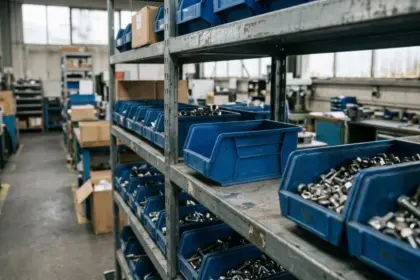
The bin is empty, a job is waiting on it, and somebody is already on the phone with the supplier.
By the end of the day, the max on that part has gone up. Maybe by a third. Maybe it doubled. You either signed off on it or never heard about it. Nobody wants to stand in front of that empty bin again, and a bigger number feels like the responsible move.
It’s usually a guess.
A stockout tells you one thing: the part you needed wasn’t there when you needed it. It doesn’t tell you why. Raising the max treats the symptom, not necessarily the problem.
Six Ways a Bin Goes Empty
After a stockout, the decision isn’t how much to raise the max. It’s whether to touch it at all. The answer has less to do with formulas than with all the ways a bin goes empty while the setting was fine.
The reorder fired on time and the supplier shipped two weeks late. One big order spiked usage in a single month that won’t repeat. Material left the bin without ever being issued, pulled for rework or borrowed for another job, so the system thought you still had plenty and never reordered. A delivery got received against the wrong part number, so the parts are in the building and invisible. Or the system said 20 on hand, and nobody could find them.
Sometimes it’s a company card. Someone has been quietly buying the part whenever it runs low, so the usage history your max was built from was never the real usage. That’s the case where the max really was wrong. The reason it was wrong is a data problem, though, and that problem doesn’t care what number you type in next.
In most of those, the setting didn’t fail. A record did, or a handoff between two people did. A bigger number on a record that’s already wrong is still wrong. It’s just wrong with more inventory behind it.
Cash on a Shelf
Every unit you add to a max is cash sitting on a shelf. It won’t show up as a line item on anything you review monthly. It shows up as working capital, and it never gets traced back to the afternoon somebody panicked over one part.
The max rarely comes back down, either. One bad day becomes the setting for the next five years. Spread that across a few hundred parts, each with its own bad day, and you’ve built a buffer whose only job is to cover for numbers you don’t trust.
You see the same bill when a customer’s orders swing and you build stock to absorb a forecast you don’t believe. Buffer inventory is what an untrusted number costs, paid in cash, every month.
The Same Reflex, Scaled Up
When stockouts start piling up, the reflex grows. Now it’s not a bigger max. It’s a bigger system: a better inventory module, a warehouse system, a planning tool with a dashboard someone saw at a trade show.
I’m not against any of those. Some companies outgrow what they have, and buying the right tool at the right time is a good decision. Every one of those tools works the same way, though. It trusts the record. If the count is wrong, the new system calculates on the wrong count faster, with nicer charts, and with a six-figure invoice attached.
You’d be paying to automate a number nobody has walked out and checked.
An Hour Before the Number Changes
You probably won’t be the one counting the bin. Your job is to make sure someone does first.
Walking a stockout backwards is plain work. Someone compares what’s in the bin to what the system says. Then they check when the purchase order went out against when the material showed up, hold what was issued up against what was used, and ask who else has been buying that part. For most parts, that’s an hour.
It ends in one of three places. The max really was too low, and now it changes with a reason instead of a reaction. A record or a handoff broke, so that gets fixed and the max stays put. Or it was a one-time event, and the right move is to do nothing at all.
That last outcome is the one people skip. Doing nothing feels like neglect when a customer just waited on you. Usually it’s the cheapest correct answer you’ll get all quarter.
None of this needs software. It needs a rule, and only you can set it: nobody raises a max without first saying why the bin went empty. That one sentence turns a reflex into a decision. It will also tell you more about whether your records match your shelves than any system demo will.
Find out which problem you have before you pay to solve the wrong one.
If you want a quick read on how far you can trust the numbers your operation runs on, the QUILT Check takes about ten minutes.
Contents
Tags
Next Article

The Printer in the Shed Was Feeding the ERP It Came From
A chemicals distributor’s ERP printed a report in a shed, and someone keyed part of it back into a different module of the same system, while load scheduling ran on a whiteboard. Nobody chose that process, and the people who implemented the system couldn’t explain it. That makes it a cost you never see on a P&L, and a trap for any replacement that automates the data flow and leaves behind the judgment calls the person in the shed was quietly making.