The Printer in the Shed Was Feeding the ERP It Came From
A chemicals distributor’s ERP printed a report in a shed, and someone keyed part of it back into a different module of the same system, while load scheduling ran on a whiteboard. Nobody chose that process, and the people who implemented the system couldn’t explain it. That makes it a cost you never see on a P&L, and a trap for any replacement that automates the data flow and leaves behind the judgment calls the person in the shed was quietly making.
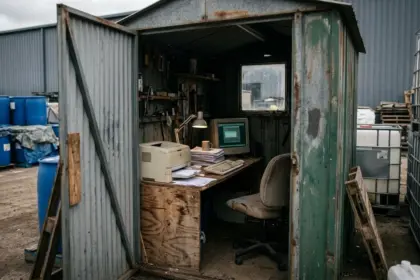
A chemicals distributor’s ERP produced a report that came off the printer in a shed as a paper copy. Then someone was expected to type some of the data on those pages back into a different module in the ERP.
I heard about this in a conversation I had recently, and I haven’t been able to put it down. The data never left the system. It just took a detour through the shed, a few sheets of paper, and a pair of hands to get from one part of it to another. Load scheduling happened somewhere else entirely. It was worked out by hand on a whiteboard, from a second printout.
When the people who implemented the system were asked why it behaved this way, they couldn’t say.
It’s a funny story until you ask what your own version looks like. Most companies have one. Very few could point to it.
Nobody chose this
No one sat in a meeting and decided the system should feed itself through a shed. That’s what makes the story worth telling.
I don’t know what broke first at that distributor, and from the sound of it, nobody there did either. Workarounds usually start the same way, though. Something doesn’t work on a busy day. A report comes out wrong, or a screen won’t do what the shipping team needs, and someone finds a way around it so the trucks still leave on time. That person is the hero of the afternoon. They should be.
Then the fix gets taught to the next hire. The person who invented it moves on. A year later it isn’t a workaround anymore. It’s the job.
A workaround you know about is a cost you’re choosing to pay. A workaround nobody remembers is a process, and people will defend it like one.
What the shed costs
The obvious cost is labor. Every retyped number is paid time producing information the system already had, plus a fresh chance for a transposed digit to land on a customer’s order.
The whiteboard is the bigger problem. The real load schedule lives somewhere your system can’t see. Every report the system gives you about shipping describes a plan that isn’t the one your team is running. You can look at the screen, make a decision, and be working from a company that only exists in the database.
There’s a people cost too. Whoever stands in front of that whiteboard knows things nobody else knows. If they’re out for two weeks, you find out quickly how much of your operation was running on their judgment.
None of this shows up as a line item on your P&L. It might not even show up as a line item on somebody’s job description. It shows up as margin that’s a little thinner than it should be, and decisions that are a little less sure than they feel.
The part nobody could explain
The detail I keep coming back to is the implementers. They couldn’t say why the system behaved that way.
I’m not pointing a finger at them. When the people closest to a system can’t explain it, the original decision has usually outlived everyone who made it. The configuration, the reason, and the person who knew the reason have gone their separate ways.
That matters most at the exact moment you’re tempted to fix it with money. If the current system is frustrating enough, a replacement starts to look like the answer, and the shed looks like the easiest win in the whole project. A report goes out, some data comes back in. Connect the two modules and you’re done.
I’ll bet it was never that simple. Whoever sat with those pages was probably making calls along the way: what to leave out, what looked wrong, what needed fixing before it went back in. Nobody wrote those decisions down, because nobody thought of them as decisions. They were just the job.
A new system that automates that data flow will move every number from one module to the other perfectly, and skip every one of those calls. Nobody will notice until the numbers start coming out wrong. The new ERP won’t know about the shed, or the judgment that lived in it. Someone will just build another one.
Finding yours
You don’t need a budget to start looking. You need a walk and a little patience.
Follow the paper. Anywhere something comes out of a system and goes back in by hand, whether into the same module or the one next to it, you’ve found a candidate. Look for the whiteboard, the spreadsheet on someone’s desktop, or the notebook by the dock where real decisions get made that the system never hears about. Then ask the person doing the work one question: why do we do it this way?
If they can tell you, good. You’ve learned something about your business. If the answer is “that’s how we’ve always done it,” you’ve found your shed.
Not every shed needs to come down. Some workarounds are cheaper than the fix, and keeping one on purpose is a perfectly good decision. The key word is “purpose.” You should be able to say what it costs and why you’re choosing to pay it. If nobody can, you didn’t choose it. It chose you.
Somewhere in your company, someone is walking paper out of a shed right now. The only question is whether you know where it is.
If you’d like a structured way to start looking, the QUILT Check is a free 10-minute self-assessment that walks through seven areas of your operation where this kind of drift tends to settle in:
https://quilt-check.the-refinery.io
Contents
Tags
Next Article
The Tsunami Is Coming, and Nobody Has Drawn the Map to Escape It
AI is making it easy for anyone in your company, including you, to build agents and one-off apps that quietly start running parts of the business, and right now all of them work. That’s the calm before the wave: those tools borrow meaning from your core systems, stack on top of each other, and keep giving confident answers long after the data underneath has changed or the person who built them has left. The fix isn’t a spreadsheet of what you’ve built; it’s a named person who owns the map and can see the ripples before they become a tsunami.